The ENISA Cybersecurity Exercise Methodology aims to empower and guide organisations in developing effective cybersecurity exercises from start to finish.
Cybersecurity exercises are essential for preparing, testing and enhancing team and system capabilities to respond to the emerging cyber threats. For over a decade, ENISA has been leading the way in cybersecurity preparedness by organising cybersecurity exercises at a local, international, and EU-wide level. One of the biggest is the biennial Cyber Europe exercise. This is a series of large-scale, cross-border cyber crisis management exercises, featuring complex realistic scenarios inspired by real-case events and threats.
In this direction, and building on its long-term experience, ENISA has developed a cybersecurity exercise methodology to provide a practical yet comprehensive approach to simulating cyber crisis and training, building resilience and agility in mitigating cyber risks.
Cybersecurity Exercise Methodology at a glance
The methodology offers an end-to-end theoretical framework for planning, running and evaluating cybersecurity exercises. Its main objective is to support organisations develop and plan exercises that are impactful and effective in building capabilities through testing their skills, processes and policies. The material is based on lessons identified, industry best practices and cybersecurity expertise. Complemented by a support toolkit that includes a set of examples, templates and practical guidance, this ENISA methodology provides a structured and straightforward approach to the whole cybersecurity exercise lifecycle. The lifecycle can be divided into six key phases:
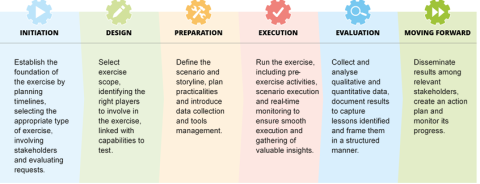
Go/no-go checklists at each stage aim to eliminate oversights, making sure that all necessary requirements are met in view of timely minimising potential risks and improving overall effectiveness.
Who can benefit from the Methodology?
This methodology aims to help professionals, organisations, and governments plan and execute cybersecurity exercises that effectively stress-test their skills and resilience. Originally developed for EU-level crisis management, this methodology is ideal for planners organising national or sector-specific exercises.
This documentation was created to be useful for organisations regardless of their current maturity level. Beyond just identifying lessons learned, it guides you in building a concrete plan to close gaps and strengthen your organisations preparedness.
Cyber Exercises by ENISA
ENISA has tested and validated the methodology in practice through past exercises, capturing both the Agency's approach to delivering exercises and reflecting the input of the growing exercise community. ENISA has been involved in organising diverse cybersecurity exercises to test the cybersecurity of the EU's critical infrastructure and its ability to coordinate cross-border responses. The Agency has been supporting the organisation of exercises, such as the annual BlueOLex exercise for EU-CyCLONe Members, as well as the EU-ELEx exercise for the European Commission and the European Parliament. Additionally, it has assisted the execution of national exercises by EU Member States (HealthEx.DK, HealthEx.LV) and other EU Institutions, Bodies and Agencies, for example the security and business continuity exercise with eu-LISA or the Joint Awareness & Preparedness Cyber Security Exercise (JASPER) with CERT-EU.
A living document shaped by real-world use
As the cybersecurity landscape continuously evolves, we also need to improve our approach, adapt our strategies and learn from each other. This methodology is designed to be a living document, not a static rulebook. All users are encouraged to actively support its evolution through the collective experience gained by its use. From practical challenges to innovative approaches and real-life examples, feedback is valuable to further enhance the methodology and eventually benefit the entire community. To share practical feedback or insights, please contact us directly at exercises@enisa.europa.eu
- ENISA Cybersecurity Exercise Methodology
- Cyber Europe | ENISA
- Cyber Europe 2024: Unveiling key insights from the cyber exercise that tested the cybersecurity of EU’s energy sector | ENISA
Contact
For press questions and interviews, please contact: press@enisa.europa.eu.
Content written for: National / EU authorities